

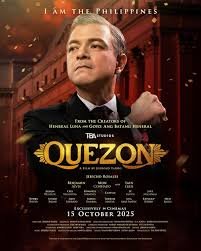
I’m not a filmmaker. But I am an avid film watcher and a lifelong student of Philippine history. Watching historical films is not just a pastime for me—it’s a passion. That’s why after watching Quezon, I found myself asking the question that lingered long after the credits rolled: What exactly are you trying to say, Mr. Tarrog?
Truth be told, I wasn’t planning to see this film at all. I had already watched the first two installments of what has been branded as the “Bayani-verse,” and, as every moviegoer knows, the third part of any trilogy often struggles to live up to its predecessors. There are rare exceptions—Star Wars, The Lord of the Rings, Harry Potter—but they are just that: exceptions.
Then came the controversy. News broke that during the movie’s premiere, a visibly upset grandson of President Manuel L. Quezon, Ricky Avencena, confronted the film’s creators. In what witnesses described as an impassioned outburst, he accused them of “opening a Pandora’s box.” That phrase caught my attention. What could possibly be so scandalous about Quezon—an already well-documented historical figure from the 1930s—that would drive his grandson to such fury?
So I gave in to curiosity. Along with my family—all eight of us—I went to watch Quezon.
And after two hours of beautifully shot yet emotionally hollow cinema, I could not understand what Avencena was so worried about. His grandfather’s reputation remains intact. The film presents Quezon much as we already know him: charming, ambitious, flawed, and deeply political. The real casualty here is not Quezon’s legacy—but the film itself.
As a viewer, I look for one thing above all when I watch a historical movie: meaning. I ask myself, What did I learn? What stayed with me? Unfortunately, Quezon offered none of that. It left me with questions, not about history, but about the filmmakers’ intent.
Was it meant to show that Quezon was a schemer? Of course he was. All politicians are, in one way or another. Was it trying to reveal that he was a womanizer or a pragmatic compromiser? Again, that’s not new. Every major political figure in our history—heroes included—was a master of compromise.
This is the film’s greatest flaw: it tries so hard to be profound that it ends up saying nothing. It is overthought, overwrought, and ultimately, underwhelming. Mr. Tarrog, who gave us the striking Heneral Luna and the decent follow-up Goyo: Ang Batang Heneral, seems trapped by his own success. In attempting to elevate Quezon into an equally grand historical statement, he loses focus—and in the process, his voice.
When Heneral Luna premiered in 2015, it shook the Filipino audience. It was bold, raw, and unapologetically honest. It reignited interest in history and gave us an unforgettable cinematic experience anchored by John Arcilla’s magnetic performance. Goyo may not have had the same punch, but it still carried a strong emotional core and a poetic narrative.
Quezon, the supposed culmination of this trilogy, sadly does not reach those heights. It makes noise, yes—but not because of its artistry. It drew attention mainly because of offscreen drama and one man’s outburst at its premiere.
But let’s be fair: Quezon himself remains a fascinating figure. His tenure marked the emergence of a new kind of Filipino politician—suave, eloquent, strategic, and modern. He was neither saint nor villain; he was a statesman of his time. That alone should have provided rich material for a compelling film. Yet what Quezon delivers is a sanitized portrait that feels neither daring nor insightful. It touches on the rivalries Quezon found himself into—from his masterful take down of his generational rivals Sergio Osmena and Manuel Roxas, down to his struggle for power with American General Leonard Wood.
The movie also touches on the rivalry between Quezon and Aguinaldo—one of the most symbolic transitions in our political history—but never digs deep enough to reveal the human cost or the moral contradictions of that power shift.
That electoral contest between Quezon and Aguinaldo was more than just a political battle; it was a metaphorical passing of the torch from the revolutionaries of the old order to the professional politicians of the new Commonwealth. It was rife with irony, betrayal, and poetic justice. Imagine the weight of Aguinaldo accusing Quezon of election fraud—when he himself stood silent as Bonifacio was betrayed decades earlier. The potential for a searing political drama was immense. Unfortunately, Quezon only grazes the surface, leaving what could have been a riveting exploration of power and legacy as mere historical reenactment.
So what are you saying, Mr. Tarrog?
After watching Quezon, I suspect the answer is: not much.
Great historical films move us not because they are accurate, but because they are honest. They give us new ways to see familiar figures, and new reasons to care about the past. Heneral Luna did that. Quezon doesn’t. It feels like a film that wants to be many things—a biopic, a moral reflection, a political commentary—but ends up being neither here nor there.
Perhaps it is time for Mr. Tarrog and company to step back from the “Bayani-verse” and ask themselves a hard question: Is there still something worth saying, or are we just repeating history for its own spectacle?
Because if Quezon is meant to teach us anything, it’s this—that even the most ambitious films can fail, not for lack of talent or resources, but for lack of conviction.
And in the end, that is the greatest tragedy of all.