

The Philippine Atomic Energy Regulatory Authority (PhilATOM) Act is the government’s proof that the Philippines is firm on using nuclear energy to boost capacity, and is committed to doing this by complying with international standards, a Department of Energy (DOE) official said on October 2.
“PhilATOM is the clearest signal of this government that we’re dead serious in getting nuclear for power generation, because that was one of the main findings even of the IAEA (International Atomic Energy Agency),” Patrick Aquino, Director IV of the DOE’s Energy Utilization Management Bureau told journalists on the sidelines of the Philippine International Nuclear Supply Chain Forum 2025 in Taguig City Thursday.
Republic Act 12305, which created the PhilATOM, was signed into law on Sept. 18, 2025.
The agency’s officials have yet to be appointed and its implementing rules and regulations (IRR) are yet to be formulated, but these two can be done at the same time, with the latter just needing consultations among stakeholders, Aquino said.
Aquino said the DOE will not be included in the consultations for the formulation of the law’s IRR because the agency will not be part of the regulatory body but will support their colleagues from the Philippine Nuclear Research Institute, as well as those from the Department of Science and Technology, Department of Health (DOH), and the Food and Drug Administration.
He said DOH and FDA will be part of the consultations because PhilATOM will also oversee the regulation of medical machines that use radiation and the like.
Meanwhile, Aquino said studies are now being done to check around 15 sites, mostly in Luzon, for possible nuclear energy power plants.
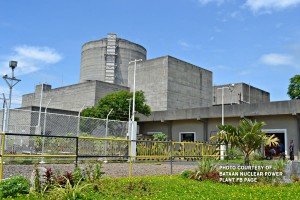
Aside from Bataan, where the mothballed Bataan Nuclear Power Plant is located, other areas being considered are Pangasinan, Palawan, Camarines Norte, and Masbate.
Aquino said most of these areas are in Luzon since it is the major island in the country that has a huge electricity demand.
He said the department considers nuclear energy as among the options that will boost domestic sources, even with the bid to increase the share of renewable energy (RE) in the total mix, to around 35 percent by 2030 and 50 percent by 2040 and beyond.
“If we consider the mix, we need to have other sources, and DOE sees nuclear as a low-carbon option that we can include here,” he said in Filipino.
Foreign investors’ interest in placing funds in nuclear energy projects in the Philippines is there, the DOE official said, but noted concerns on regulatory certainty.
This is the reason why the PhilATOM was established, since the government would not have access to nuclear industry sector players if it does not have safe practices measures in place.
“And now, even in the energy sector, we’re very clear that we’re investing in the Philippines and to make sure that we have a competitive energy supply. We have to start thinking and investing the seeds for the entry of nuclear in the medium and long term,” he added.
BNPP FACEBOOK PHOTO