

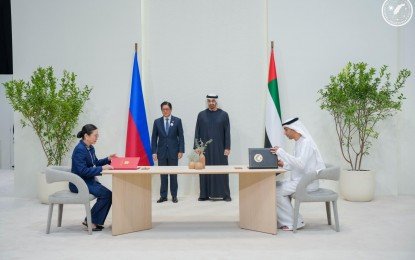
The Comprehensive Economic Partnership Agreement (CEPA) between the Philippines and the United Arab Emirates (UAE) is seen as a key driver of long-term economic resilience for the Philippines.
The CEPA was signed Tuesday on the sidelines of the Abu Dhabi Sustainability Week 2026 Summit at the Abu Dhabi National Exhibition Center, with Department of Trade and Industry Secretary Cristina Roque signing on behalf of the Philippines, according to a statement released Wednesday by the Presidential Communications Office (PCO).
President Ferdinand R. Marcos Jr. and UAE President Sheikh Mohamed bin Zayed Al Nahyan witnessed the signing ceremony.
In a separate statement, the Philippine Chamber of Commerce and Industry (PCCI) described the CEPA as “a landmark step in expanding Philippine trade, investment, and global market access.”
“The UAE serves not only as a major destination for Philippine exports but also as a global gateway linking Asia, the Middle East, Africa, and Europe,” PCCI President Perry Ferrer said.
He said the agreement gives exporters, investors, and small and medium enterprises a stronger platform to expand operations in the UAE and the broader Middle East.
Ferrer added that the CEPA would help diversify the Philippines’ trade partnerships and lessen dependence on traditional export markets. By tapping the UAE’s logistics and re-export networks, the deal enhances trade resilience and supports sustained economic growth.
He said the agreement creates new opportunities in food and agriculture, manufacturing, construction materials, and digital and professional services, while enabling Filipino service providers to compete under more predictable and non-discriminatory conditions.
“Finally, we have an agreement that will allow our small businesses to export products, offer services, and partner with UAE companies more easily,” Ferrer said.
PCO PHOTO